

Speed Optimization

Website speed optimization in Orangeville

Website speed optimization for Orangeville business sites, tested the way Dufferin customers really open them: on a phone, often on mobile data, sometimes on a patchy signal out in the hills.

  • Core Web Vitals
  • Mobile data
  • Image sizing
  • Script clean-up
  • Caching
A phone showing three green speed gauges with a rural highway and snowy fields ahead

Your website speed is different on a sideroad in Mono

Test your website at your desk in town and it probably feels fine. The connection is quick, the computer is recent, and your browser has stored half the page from your last visit. Now picture a customer opening it for the first time on an older phone, on mobile data, parked at a farm gate in Amaranth, at a trailhead near Mono Cliffs, or on the bus to Brampton. Then the same page can take many times longer.

That slower visit is where a page has to perform. Someone who waits too long goes back to the search results. Meanwhile, Google’s ranking systems draw on speed measurements collected from real Chrome visits. That is why website speed optimization, which makes each page lighter, helps on both counts.

Weak signal in the hills is part of daily life here, but nothing on our side changes it. Instead, what we can change is how much your site asks that connection to carry.

  • 75% of real visits must meet each target
  • 28 days of Chrome data behind the verdict
  • 3 Core Web Vitals Google reports
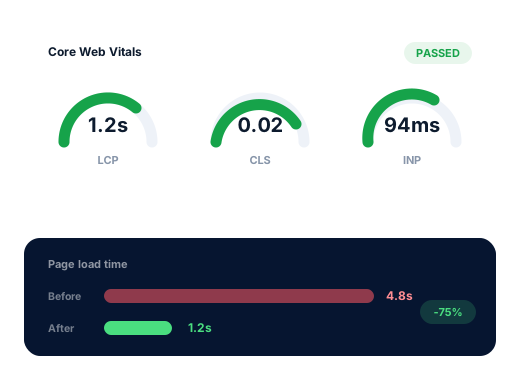
Website speed optimization illustration: three dial gauges in the green zone beside a shorter load-time bar

Search demand

How owners describe website speed problems

General Google searches; there are no Orangeville-specific suggestions for site speed. People start with the symptom and pick up the vocabulary later.

Search term Intent Why it matters
website loading slow on mobile Research Noticed on their own phone, often by accident.
how to speed up wordpress site Research Ready to try fixes themselves before calling anyone.
core web vitals Research Has met the term, perhaps in a Search Console email.
reduce image size for website Research Has found the most common culprit.
lcp issue longer than 2.5s mobile Urgent Copied straight from a Search Console warning.
website speed optimization service High Wants someone else to do the work instead.

Pass with real visitors, then stop

PageSpeed Insights puts a score out of 100 at the top of its report, and it is easy to fixate on. However, that number comes from a simulation. The part Google uses for ranking is the field data from real visits, which simply says pass or fail on each measure. We aim to get that section passing on mobile and then stop, because shaving the last few points off a lab score rarely changes how many people call.

Where the seconds go

Where website speed leaks away on a typical Orangeville site

A typical slow site has two or three of them at once.

  1. 01

    Photos uploaded straight from a camera

    One phone photo can weigh several megabytes and then be displayed in a box a few hundred pixels wide. On a rural mobile connection that single image can account for most of the wait. Resizing it and using a modern format such as WebP fixes it.

  2. 02

    A visual page builder

    Drag-and-drop builders are convenient, but they load a large library of code on every page, whether that page uses it or not.

  3. 03

    Add-ons nobody reviewed

    Pop-ups, live chat, social feeds, a pair of analytics tags and an embedded map: each adds requests, yet many were installed once and then forgotten.

  4. 04

    Cheap, crowded hosting

    If the server takes a second or more just to begin replying, nothing else on the page can win that time back.

  5. 05

    No caching

    Every visit rebuilds the page from the database. Caching hands over a ready-made copy instead, which is far quicker for returning visitors.

What Google measures

How Google measures website speed: LCP, INP and CLS

The pass marks below are set out in Google’s write-up of the three metrics, which Search Console also reports on. Your scores are built from 28 days of Chrome visits by real people, so a page passes only when three in four of those visits reach every target.

01

Largest Contentful Paint (LCP)

Loading

How long until the biggest thing in view, usually the main photo or headline, has finished drawing. Google’s target is 2.5 seconds or under. An oversized hero image and a sluggish server response are the common causes of a slow result.


02

Interaction to Next Paint (INP)

Responsiveness

The pause between tapping something and seeing the page react. The target is 200 milliseconds or less. Chat widgets, sliders and stacks of tracking tags are the usual reason a page feels sticky.

03

Cumulative Layout Shift (CLS)

Stability

How much content jumps around as the page loads, which is how people end up tapping the wrong button. Keep it below 0.1 by giving images fixed dimensions and reserving room for anything that arrives late.

The work

What a website speed optimization project involves

01

Measure before touching anything

Field and lab figures for your most important pages recorded first, so the result can be shown rather than claimed.

02

Images sized for their slot

Each picture scaled to the box it actually occupies, compressed, delivered as WebP where the browser supports it, and held back until the visitor scrolls near it.

03

Fewer scripts, loaded later

Unused plugins removed, non-essential scripts deferred until after the page appears, and fonts hosted on your own domain.

04

Caching tuned to your host

Page and browser caching configured for the server you are on, so returning visitors barely wait.

05

An honest view of hosting

If the server is the bottleneck, we show you the response times and the alternatives; whether to move is your decision.

06

Re-measured afterwards

Lab results checked the same day, and field data reported again once Google’s 28-day window has caught up.

Done carefully

Website speed claims we avoid

Rules we keep for every client, written down so you can hold us to them.

Fair warning
A quick site cannot make up for thin pages, and you also do not need a perfect score to rank in Orangeville.

Speed is one signal among many, and its clearest payoff is fewer people giving up before they reach you. When your site is fast enough, we will say so and point to where the next dollar would do more, such as new service pages or your Google listing. We quote website speed optimization as a one-time job after an audit.

Tested on
Phones on mobile data
Evidence
Before-and-after figures
Finished when
Field data passes
Ask us about your business
A notebook of handwritten figures beside a calculator on a kitchen table
  • No promise of a score of 100.
  • No cloaking: Google sees the same page your customers do.
  • No removing features you use without asking first.
  • No rebuild pitched when a repair would do.

How we work

How we work, step by step

Four stages, from being overlooked to being the first name Orangeville sees.

  1. 01

    Look closely

    We check your site, your Google profile and where you rank from town and from the countryside, then list what is holding you back.

  2. 02

    Choose the searches

    We decide which searches are worth winning and match each to one page, so nothing on your site competes with itself.

  3. 03

    Do the work

    Profile, website, content and directory fixes, carried out with the most valuable changes first.

  4. 04

    Report and refine

    A short monthly summary of calls, messages and rankings, with next month’s priorities spelled out.

Questions

Website speed questions

How do I test my own site?

Open PageSpeed Insights, paste in your address and pick the mobile results. Look first at the real-visitor section; if Google says there is not enough data, the lab figures underneath are a fair guide. Then try the site on your phone with wifi switched off.

Can you make it fast for customers with a weak rural signal?

We cannot improve the signal, but we can cut how much each page has to download. So a lighter page is the biggest single help for anyone on a slow connection.

What counts as fast enough?

Main content visible on a phone inside 2.5 seconds, taps answered in under 200 milliseconds, and nothing shifting while the page loads.

Will a faster site rank higher?

Sometimes, when you are neck and neck with a competitor. Still, the more dependable benefit is that more visitors stay long enough to call or book.

How long does the work take?

The work itself usually takes a week or two for a small site. Because Google averages field data over 28 days, the official pass shows up roughly a month later.

What does speed work cost?

Website speed optimization is a one-time job, quoted in Canadian dollars after an audit, because every site has a different mix of problems. On a monthly plan, keeping the site quick afterwards falls under the ongoing technical upkeep.

Works best alongside

Other services for Orangeville businesses

Each service supports the others: a fast site helps rankings, rankings lower ad costs, and a complete listing lifts everything.

See all services

Further reading

From the blog

More reading on this topic for Orangeville business owners.

See where you stand in Orangeville

Request a free audit: where you rank in town and across the townships, who sits above you, and the fixes worth making first.

Get your free SEO audit